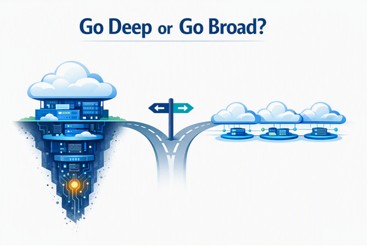
The cloud certifications continue to stack up on LinkedIn profiles like badges of honour. AWS Solutions Architect. Azure Administrator. Google Cloud Professional. OCI Architect Professional. But behind those shiny credentials sits a real career question that I don’t think gets enough honest discussion: should you go deep on one hyperscaler, or spread your learning across multiple hyperscalers?
It’s a question I’ve been trying to decipher since I started training on public cloud, and working on customer projects, back in 2017. It’s one that I have discussed with my peers and been asked by those I mentor. But I have never found a common consensus, just a lot of “Well, it depends…” and people leaning strongly one way or the other. So, I decided to investigate this a bit further: the case for deep learning on one hyperscaler and the case for multi-cloud fluency. Where it led me was to a thought I never considered back in 2017, but funnily enough, where I have ended up being!
The Case for Going Deep on One
Each major hyperscaler - AWS, Azure, Google Cloud, Oracle Cloud - offers hundreds of services. AWS alone has over 200. These aren’t shallow offerings either; each service has its own design patterns, best practices, pricing models and failure modes. To truly architect resilient, secure, and scalable systems within a single platform demands genuine immersion.
There is also a compounding effect to deep expertise. When you understand how IAM policies interact with VPC configurations, how event-driven architectures behave under load, or how a particular database service handles failover - that’s knowledge built through hours of hands-on work, not something you pick up from a weekend crash course on a second platform. Depth creates the kind of intuition that lets you troubleshoot production issues at 2am, and that’s what some employers will pay a premium for.
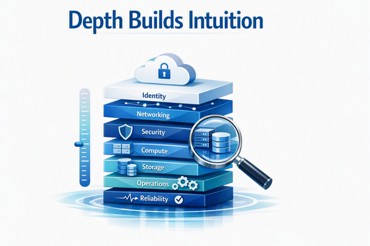
The certification roadmap advice from experienced practitioners tends to reinforce this: don’t chase multiple clouds in your first year. Depth beats breadth as a hiring signal, particularly for roles like Solutions Architect or DevOps Engineer, where you’re expected to make nuanced platform decisions daily. A candidate who deeply understands one platform’s networking model, security boundaries, and operational tooling will typically outperform someone with surface-level familiarity across three.
There’s also the practical reality of how most organisations operate. Despite the multi-cloud buzz, many companies still run primarily on a single provider. If your employer is an AWS shop, your Azure knowledge is interesting but not immediately deployable. Context matters. Even organisations with some form of multi-cloud setup have tended to keep dedicated hyperscaler practices and cloud centres of excellence.
The Case for Multi-Cloud Fluency
The industry is now shifting. Multi-cloud is no longer a theoretical best practice - it’s an operational reality in medium-to-large enterprises. Different teams within the same organisation choose different providers based on specific strengths. AWS for infrastructure maturity. Google Cloud for data and AI workloads. Azure for tight integration with Microsoft enterprise tooling. The result is that professionals increasingly encounter multiple platforms whether they planned to or not.
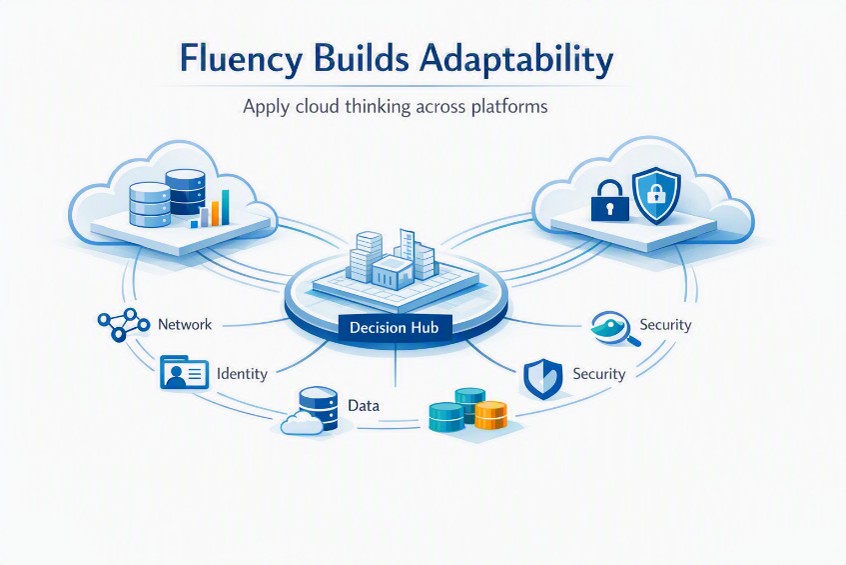
Recruiters have started to notice. Research from recruitment firms specialising in cloud roles suggests that professionals with experience limited to a single cloud may find their career progression start to be restricted. The feedback isn’t about a lack of depth - it’s about a lack of adaptability. Organisations now want engineers and architects who can reason about cloud architecture abstractly and then apply that reasoning to whichever platform a given workload demands.
Multi-cloud skills also command a salary premium. Reports from 2026 indicate that professionals with demonstrated competence across two or more hyperscalers earn meaningfully more than their single-cloud counterparts - in some analyses, upwards of 25%. The premium reflects the scarcity of people who can operate confidently across platform boundaries while still making sound architectural decisions.
There’s a transferability argument too. The fundamentals of cloud computing - networking, identity management, compute orchestration, storage tiers, observability - exist in every hyperscaler. Learning a second platform after mastering the first is significantly easier than learning the first was. Concepts transfer even when the service names and APIs differ. Someone fluent in AWS VPCs will pick up Azure VNets extremely quickly because the underlying mental model is similar.
The Real Answer: Sequence Matters More Than Choice
The debate between specialisation and breadth is somewhat false. It’s not really a binary choice - it’s a sequencing problem.
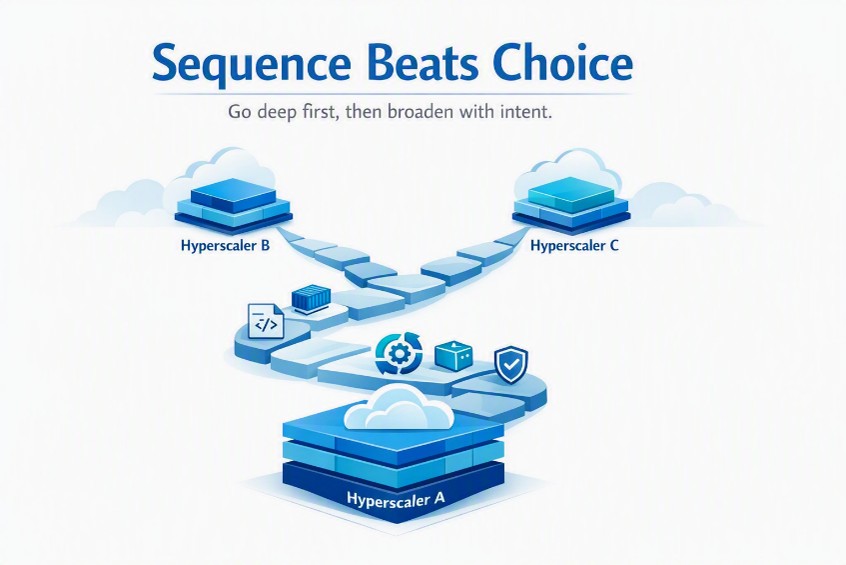
The most effective approach, based on both the career data and the practical realities of skill-building, looks something like this: go deep with one hyperscaler first, then broaden out into a second or third.
So, starting with one hyperscaler. Learn it properly. Earn the intermediate and professional-level certifications. Build real things on it. Understand not just what buttons to press but why certain architectural patterns exist. Develop the muscle memory of deploying, monitoring, and troubleshooting in production. Give yourself twelve to eighteen months of focused immersion.
Then branch out. Add a second platform with intention. The cloud-agnostic concepts you’ve already internalised - infrastructure as code, container orchestration, CI/CD pipelines, security posture management - will transfer. You’ll find yourself learning the new platform in months rather than years because you’re mapping new syntax onto existing understanding.
Kubernetes and similar platform-agnostic technologies offer a useful middle ground here. Learning container orchestration that runs consistently across AWS EKS, Azure AKS, and Google GKE gives you portable skills without requiring you to master each platform’s full-service catalogue. Similarly, tools like Terraform and Ansible let you express infrastructure in ways that translate across providers.
What About the Market?
The enterprise trend toward multi-cloud isn’t slowing down. Outages, pricing changes, and feature gaps have pushed organisations toward diversified strategies. Vendor lock-in is a genuine concern, and companies increasingly want technical staff who understand the trade-offs and can design for portability where it matters.
But, and I think this is important - multi-cloud doesn’t mean equal investment in every platform. It means being able to make informed decisions about which workload belongs where. It means understanding enough about each platform’s strengths and weaknesses to architect intelligently rather than defaulting to a single vendor out of habit.
The Bottom Line
So, should your hyperscaler knowledge be exactly one, or greater than one? I think the answer is: start with one and let it grow to at least two.
Deep expertise in a single platform gives you the foundation that makes everything else possible. It builds the architectural intuition, the operational instincts, and the credibility that employers value. But staying locked to a single platform in a now multi-cloud world is an increasingly limiting choice.
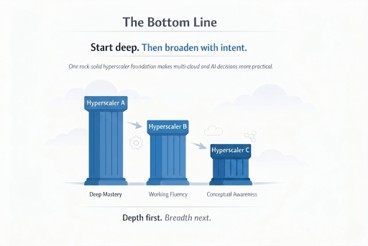
The sweet spot for most cloud professionals in 2026 is deep mastery of one platform, working fluency in a second, and enough conceptual understanding to navigate a third when needed. And I don’t think that is a compromise - it’s a strategy. It is one that both the market data and recruiters seem to agree on.
I’ve written this post from the perspective of a cloud architect, because that is the role I have been in for more than a decade now, but I do think the principle also applies more broadly. Developers, engineers, DevOps specialists, data engineers and security professionals may need different levels of depth in different services, but the same pattern holds: build strong practical depth in one hyperscaler first, then broaden with intent. Certification and career pathways from AWS, Microsoft and Google Cloud increasingly reflect this role-based split, with different tracks for architects, developers, engineers, security and data specialists rather than one generic cloud route. So, I would frame this as advice for cloud professionals in general, while acknowledging that architects probably feel the full force of the multi-cloud decision-making challenge most directly.
But which hyperscaler should you go deep on first? I touch on what my logic was at the time in the next section, and I think this still holds true. Look at the roles your organisation has today and ask about the pipeline. You want to know that once you have done the study, you are going to be able to use it and gain real experience with a customer. As with most knowledge, if you don’t use it, you lose it. So, you want to be putting the theory into practice straight away.
There is, of course, another big element to this now that didn’t exist for me back in 2017: AI. It may feel like AI should be the first deep dive, but the most useful AI skills still depend on cloud fundamentals such as data platforms, identity, networking, security, operations and the hyperscaler services that host them. So, my view is: learn cloud deeply enough to make AI practical, then use AI as the lens for deciding where to specialise next.
And so, for me, your hyperscaler knowledge should be greater than one. But make sure that first one is rock solid before you start adding! Depth creates confidence. Breadth creates adaptability.
My Personal Journey
The thought of this being a sequencing problem never really occurred to me back in 2017, when I was trying to figure out how to focus my efforts and get the most out of the time I could afford to invest.
I looked at the organisation around me: separate practices were forming for each hyperscaler, and people were starting to be aligned. You basically had to be aligned to an AWS, Azure or Google Cloud practice.
I remember feeling at the time: I don’t want to be pigeonholed here; I want to be a Cloud Architect, not an AWS, Azure or GCP Architect. But one guy going against the grain doesn’t have an impact in a global organisation.
So, I went all in on AWS, racing to 5 certifications quickly. Why did I do that? I think for two reasons. Firstly: I felt AWS was the market leader and we’d be getting a bigger pipeline of work with them. Secondly: I was managed/mentored by someone who was absolutely ‘all in’ on AWS.
It also felt like there was a lot more ‘buzz’ and ‘hype’ around AWS. It felt like there was more going on with them. They were dynamic, they were exciting, and they were the cool kids releasing new and valuable services. The learning opportunities and touchpoints with AWS seemed vastly greater than with Microsoft or Google. AWS had Game Days, the London Summit, DeepRacer and a multitude of sessions you could attend at their offices.
So, over a period of 2-3 years, I cemented my hyperscaler knowledge on AWS. I picked up further certifications as well as hands-on experience working with customers.
However, I seemed to have a bit of a mental shift again at this point. I could see more work emerging in our organisation on Azure. This seemed to be especially prevalent with our public sector customers. I also got aligned to one of our organisation’s first deliveries on GCP. I am assuming this was because I had ‘Cloud’ skills, not because I had any GCP certifications or experience at the time.
It made me feel like diversification was going to be necessary to keep me utilised. I would be able to be assigned to any work request that came in, whether that be for AWS, Azure or GCP and that would be a real ‘brand’ and career booster!
I started putting effort into Azure certifications. But what I didn’t want to do was spend a lot of time going back over basic cloud concepts — things that were essentially the same, just named differently, perhaps with a few minor quirks here and there. I also didn’t want to spend too much time on Azure certifications that were perhaps on the fringes of what I was likely to need in my day job. So, I was quite strategic in the Azure certifications I went for and tried to make the best use of the time I had available for study.
With this seemingly going quite well, and me consequently landing on a big piece of Azure work, I wanted to repeat the pattern and go for my third hyperscaler. With a bit of real-world architecture experience on GCP already, I took an even more focused and strategic approach and just went for a single GCP certification, with the ambition that it would get me on further GCP work and boost my career credentials even further. Up to today, I still have and maintain just that single GCP certification.
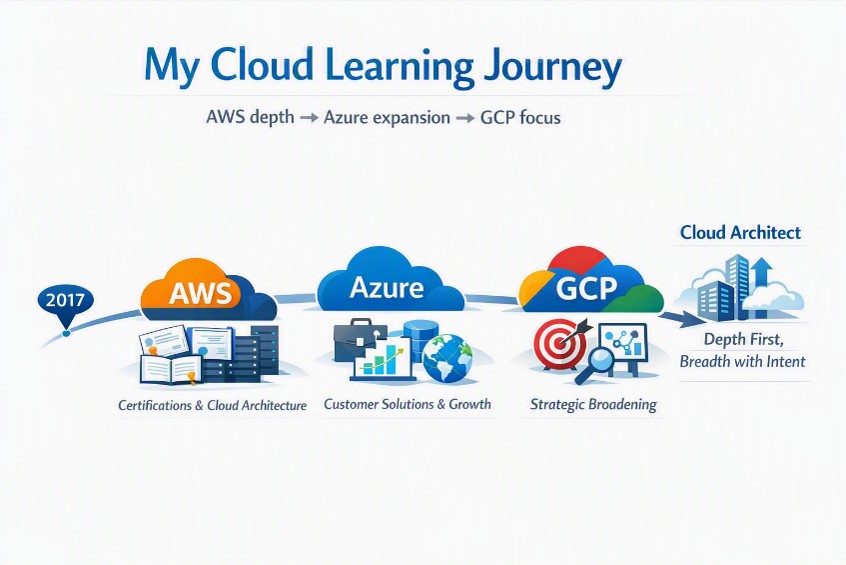
So, I think I pretty much followed the path my investigations have now led me to, but completely unwittingly! I went all in on AWS at the beginning, built my knowledge and experience up to a strong place, and then strategically looked at the best way to expand my knowledge into Azure and GCP.
For those I talk to or mentor now, I advocate going deep on one hyperscaler first and getting your cloud domain knowledge strong. Then use that foundation to expand your knowledge into one or two more hyperscalers in a focused manner. Currently, I feel this puts you in the strongest position for what the market is looking for.
Matthew Knight is multi-cloud architect at Atos, holding certifications across AWS, Azure, and Google Cloud.